

Confused by BJJ Gi sizing? This BJJ Gi sizing guide explains how A0–A5 sizing works, why gis vary between brands, how to measure yourself, and how to avoid the most common sizing mistakes.
Buying a BJJ gi online should be straightforward. It rarely is.
You find a gi that looks right, check the size chart, and still end up second-guessing yourself. Too long in the sleeves. Too tight through the shoulders. Runs small compared to the last one you tried.
Sounds familiar? You are not doing it wrong. BJJ gi sizing is genuinely more complicated than buying a regular piece of clothing, and there are real reasons for that. Understanding those reasons makes the process a lot less frustrating.
This BJJ Gi sizing guide walks you through everything you need to know: how the sizing system works, why variation happens, how to measure yourself properly, and how to pick the size that will actually fit the way you train.
See the Video on our YouTube channel if you’re more visual.
How BJJ Gi sizing works
BJJ gis do not follow standard clothing sizes. There is no small, medium, or large. Instead, gis use an alpha-numeric system. A0 through A5 for adult sizes, where the letter stands for Adult and the number indicates a general size range.
Here is the basic breakdown:
A0 — typically fits smaller frames, roughly 5’3″ to 5’5″, up to around 130–140 lbs
A1 — fits lighter to average builds, roughly 5’4″–5’8″, 140–165 lbs
A2 — the most common size, fits average to athletic builds, roughly 5’7″–5’11”, 165–185 lbs
A3 — fits larger athletic builds, roughly 5’10″–6’2″, 185–220 lbs
A4 — fits bigger frames, roughly 6’0″–6’3″, 220–260 lbs
A5 — fits the largest frames, 6’2″+ and 260 lbs+
These ranges are approximate. They are starting points, not guarantees. A practitioner who is 5’9″ and 190 lbs might fit comfortably in an A2 from one brand and need an A3 from another. That inconsistency is real, and it is not random.
Why sizing varies and why that is not always the brand’s fault
Most BJJ gis are produced overseas, and most are still largely handmade. That combination introduces natural variation that even well-run brands cannot fully eliminate. The upside is that people are earning living wages, take that Skynet!
When a gi jacket is cut and sewn by hand, there will always be a small margin of error from one unit to the next. A sleeve that measures 62 cm on one gi might measure 63.5 cm on the next one off the line. The difference is minor. But if you are already on the edge of a size, that margin matters.
Vendor relationships and quality control plays a significant role here. Brands with strong, consistent relationships with their manufacturers and rigorous QC processes produce tighter tolerances. Brands cutting costs or working with lower-tier vendors produce wider variation. This is one of the reasons construction quality and brand standards matter beyond just the materials themselves.
None of this means you should expect a badly fitting gi. It means you should go into the purchase informed. Measure yourself, use the brand’s specific size chart, and leave a little room for natural variation.
Cotton vs. engineered blends: the shrinkage factor
Fabric choice affects fit in a way most buyers do not anticipate until after the first wash.
Traditional 100% cotton gis shrink. Depending on the weave weight and how the gi is washed, a pure cotton gi can shrink noticeably after the first few washes, enough to change how it fits through the shoulders, sleeves, and pants length. This is why many practitioners size up slightly when buying a pure cotton gi, expecting it to shrink into the right fit over time.
Engineered blends which is typically a cotton-polyester mix, behave differently. The polyester component stabilizes the fabric, significantly reducing shrinkage. With proper care, a well-made blend gi should hold its size and shape wash after wash.
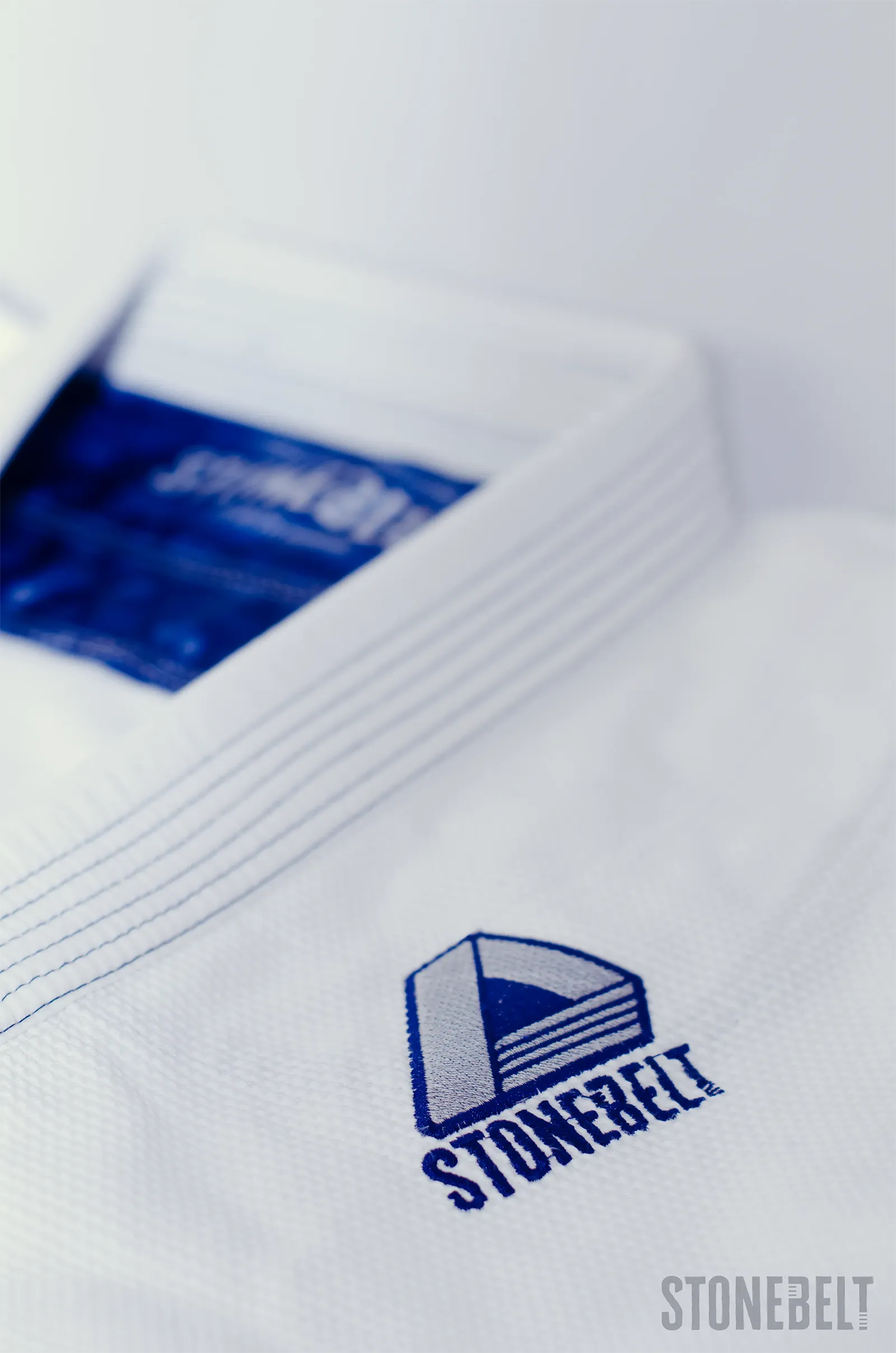
The Stonebelt Heritage BJJ Gi uses a 70/30 cotton-poly blend specifically for this reason. Under normal care, meaning you cold wash & air dry the gi, expected shrinkage is effectively zero or very little. The size you order is the size you wear, session after session.
That said, there is a useful flip side to the shrinkage equation worth knowing.
If your gi fits slightly large, you can use heat intentionally to bring it in. Wash hot and tumble dry, and a blend gi will shrink by roughly 2%, while full cotton gi can shrink about 5%. It is not a dramatic change, but it can be enough to improve the fit when you are caught between sizes. Once you have the fit where you want it, switch back to cold wash and air dry to lock it in. From that point on, the gi should hold its shape.
This is not something most brands will tell you. But if you train long enough, you will hear it on the mat eventually and from personal experience, I can tell you it works! Better to know it going in.
How to measure yourself for a BJJ gi
The size chart is only useful if you know your measurements. Estimating based on your regular clothing size will get you close but not close enough.
Here is what to measure:
Height — standing straight, bare feet. This is the single most important measurement for sleeve and pants length.
Wingspan — Measure from tip of the hand to the other, while arms streched out straight across a wall. Keep arms out perpendicular and ask someone to help you take the measure.
Weight — current, not approximate. Gi sizing ranges are weight-sensitive, especially at the edges of each size.
Chest — measure around the fullest part of your chest, under the arms, keeping the tape level. This determines jacket fit through the torso.
Waist — measure around your natural waist for pants fit reference.
Hips — measure around the widest part of your hips and seat. Relevant for pants fit, especially for stocky or athletic builds.
Once you have those numbers, compare them against the brand’s specific size chart — not a generic BJJ sizing chart from an unrelated source. Every brand cuts differently. The only chart that matters is the one for the gi you are buying.
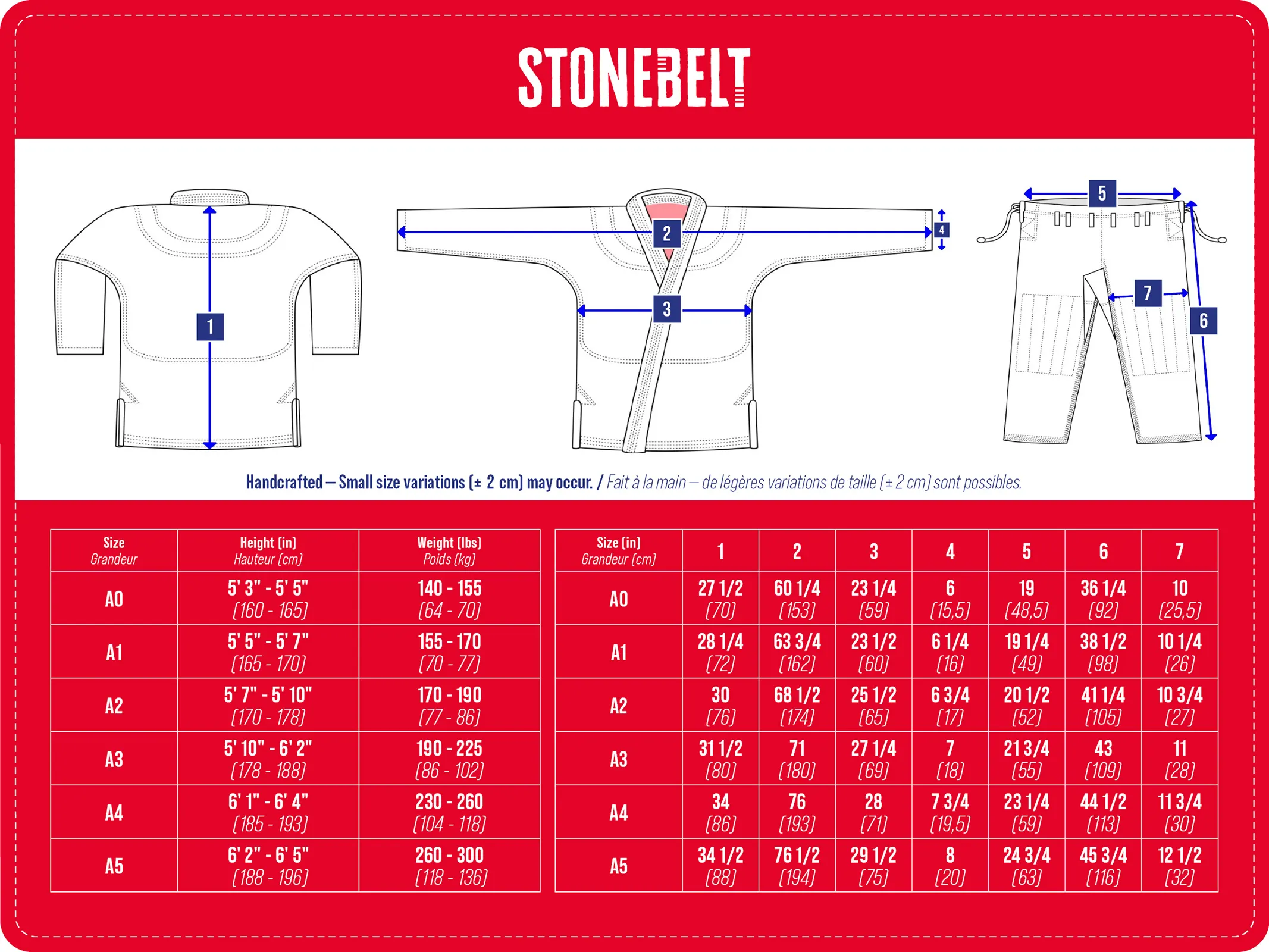
For the Heritage BJJ Gi, use our sizing chart directly:
Heritage BJJ Gi Sizing Chart →
Take the time to actually check your measurements against it before ordering. It takes two minutes and saves a lot of frustration.
A note on fit for stocky and shorter builds
Standard A0–A5 sizing was built around an average body proportion. If you are shorter and stockier, wider through the chest and shoulders but not particularly tall, you have probably already discovered that standard sizing does not always serve you well. A size that fits through the torso runs long in the sleeves. A size that fits the length feels tight everywhere else.
The industry has started to respond to this with extended sizing options from A1L (long), A2H (husky), A2L, A3H which accounts for practitioners who do not fall neatly into the standard proportions. These sizes are becoming more common, and Stonebelt plans to offer them as demand grows.
For now, if you are working with standard sizing and find yourself between fits, use the measurement-first approach and the shrinkage tip above. And take advantage of the free size exchange it exists precisely for situations like this.
What to do if you are between sizes
When your measurements land right on the border between two sizes, default to the larger one.
A gi that is slightly large can be trained in, broken in, and if needed, carefully shrunk with heat. A gi that is too small cannot be fixed. Seams under tension fail faster, mobility suffers, and the fit never improves.
Leave a little room. Jiu-jitsu is dynamic. You need a gi that moves with you, not one you are fighting against every time you shoot for a takedown or work from guard.
Free size exchange = order with confidence
Even with the right measurements and the right size chart, sometimes the fit is not perfect. Bodies are different. Production has natural variation. It happens.
That is why every Stonebelt order comes with a free first size exchange. If the gi does not fit the way it should, you can exchange it for a different size at no extra cost. No complicated process. No penalty for getting it wrong.
Sizing anxiety is one of the most common reasons people hesitate on a gi purchase. It should not be. Buy the size that looks right based on your measurements, try it on, and if it needs to change, we will take care of you!
That is the standard that makes sense for practitioners buying gear they cannot try on first.
The bottom line
BJJ gi sizing is not as simple as picking a t-shirt off a rack. The system is different, the production reality introduces variation, and fabric choice affects how the gi fits over time.
But none of it is as complicated as it looks once you understand the basics. Measure yourself. Use the brand’s actual size chart. Factor in the fabric. Leave a little room. And if you get it slightly wrong, fix it with heat or swap the size.
The goal is gear that fits well and stays out of your way. Because when the gi is right, you stop thinking about it entirely, which is exactly where your focus should be.
If you are ready to find your size, start with the Stonebelt Heritage BJJ Gi and the sizing chart above. Everything you need to make the right call is right there.
Mike